
MoneyAfrica| Investment Research
Weekly Market Commentary
April 27, 2026.
Good morning, readers, and welcome to this week’s edition of our stock market newsletter!
As always, our newsletter is divided into two sections: Green White Green, covering the Nigerian stock market, and the Star-Spangled Banner, focusing on the US market.
Green White Green Recap
MacroUpdate
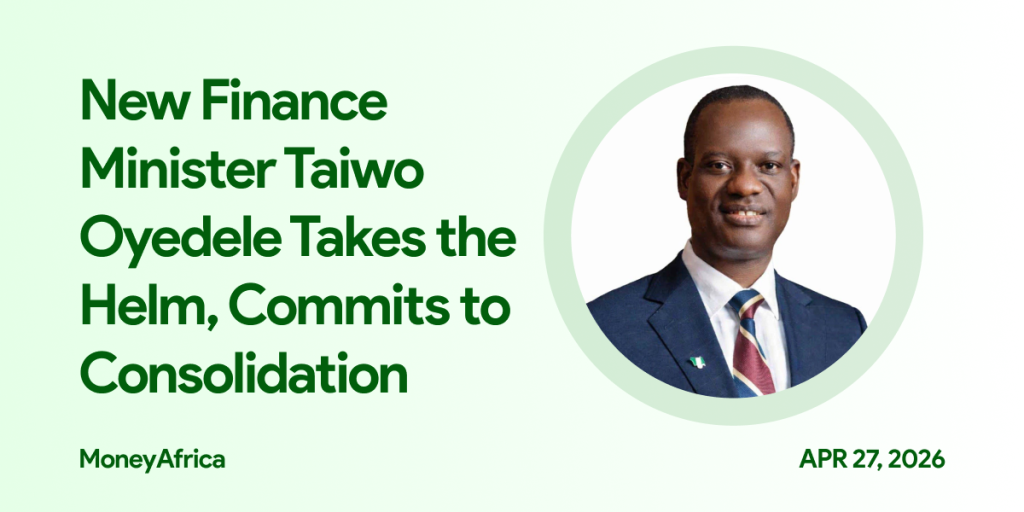
New Finance Minister Taiwo Oyedele Takes the Helm, Commits to Consolidation
In a significant cabinet reshuffle this week, President Bola Tinubu appointed Taiwo Oyedele as the substantive Minister of Finance and Coordinating Minister of the Economy. Oyedele, who formally assumed office on Thursday, April 23, 2026, succeeds Wale Edun after previously serving as the Minister of State for Finance and Chairman of the Presidential Committee on Fiscal Policy and Tax Reforms.
Upon taking office, Oyedele emphasized a shift from “reform to result,” pledging to consolidate the fiscal gains of his predecessor while deepening ongoing structural changes. His immediate priorities include:
- Fiscal Discipline & Debt Management: Strengthening transparency and prudent management of public resources to address Nigeria’s ₦159.28 trillion debt burden.
- Revenue Mobilisation: Expanding the tax base and harmonising revenue administration through the newly established Nigeria Revenue Service (NRS).
- Electricity Subsidy Removal: The government is moving forward with plans to share the burden of electricity subsidies with state governments beginning in 2026, aimed at preventing “hidden liabilities” in the power sector.
What does this mean for you? The appointment of Oyedele, a career tax and fiscal policy expert, signals that the government is doubling down on tax-led revenue growth. While you should expect stricter fiscal discipline, there is some relief for lower earners: new tax laws taking effect in 2026 exempt individuals earning ₦800,000 or less annually from income tax and remove VAT from essential items like food and electricity. However, with the ongoing push for subsidy removal in the power sector, electricity tariffs are expected to reflect true market costs, potentially increasing the monthly bills for many households.
Key Takeaway: The “Taxman” is now in charge of the national purse. Oyedele’s focus on revenue and discipline is a clear sign that the government will continue to prioritize debt sustainability and fiscal reform over populist spending. For Nigerians, this means a more predictable tax environment but also the eventual end of broad energy subsidies as the state moves toward a market-driven economy.
FX Update
Naira Depreciates Slightly in Official Window: Spread Narrows to ₦21
The Naira experienced a slight depreciation in the official NFEM window this week, closing at ₦1,358.66/$1 on Friday, April 24. This represents a 1.2% (₦16.16) decline from the ₦1,342.50 recorded at the close of the previous week. Despite this movement, the exchange rate showed relative stability.
In the parallel market, the Naira appreciated to ₦1,380/$1, up 1.4% (₦20) from the ₦1,400 seen at the end of last week. This opposing movement between markets resulted in the spread narrowing significantly to approximately ₦21.34, down from the ₦57.50 gap reported seven days ago.
Nigeria’s gross external reserves fell to $48.45 billion as of April 24. This reflects a $270 million (0.55%) decline from last week’s $48.72 billion. The persistent daily drain, totaling roughly $1.57 billion since the March 11 peak, suggests that the CBN is actively providing liquidity to defend the Naira’s stability.
Key Takeaway: The Naira is stable because the CBN has spent over $1.5 billion from its reserves in just over a month to defend the currency. The narrowing spread is a positive sign for market convergence, but it relies heavily on the Bank’s continued intervention.
Remember to save dollar-based goals in dollars, which can be done with apps like Ladda. Visit www.getladda.com to download. You can earn up to 8% for dollar savings and 20% by investing in naira savings.
Equities Update
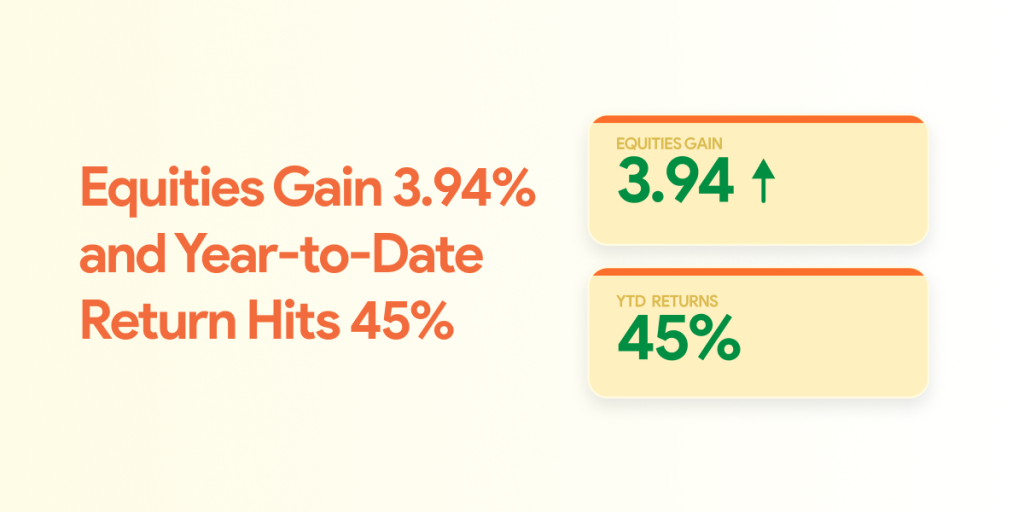
Equities Gain 3.94% and Year-to-Date Return Hits 45%
The Nigerian stock market delivered another robust performance, with the All-Share Index (ASI) appreciating by 3.94% to close at 225,722.49 points. This pushes the year-to-date (YTD) return to a staggering 45.05%, a significant leap from the 39.56% reported last week. Investor confidence remains high, with total turnover rising 9.5% to ₦213.95 billion.
Financial Services remained the heartbeat of the exchange, gaining 2.45% for the week and accounting for 72.1% of total turnover volume. Oil & Gas continued its exceptional streak, gaining 8.12% for the week as its YTD return crosses 110%. Consumer Goods appreciated by 1.85%, recovering further ground. Industrial Goods edged higher by 0.65%. Insurance finally turned positive, gaining 0.95% after weeks of decline.
With the market up 45% this year, stocks are becoming expensive and a price correction is likely. Investors should remain observant, as we expect many traders to start taking profits soon to lock in recent gains. While the FTSE Russell reclassification and upcoming bank dividends could provide further momentum, the market’s current pace is becoming difficult to sustain. Rather than chasing the rally at these levels, a more cautious approach may be beneficial, allowing investors to wait for a potential pullback to find more attractive entry points.
Key Takeaway: A phenomenal run continues with the ASI gaining nearly 4% this week. However, with valuations getting stretched and YTD returns hitting 45%, the risk of a pullback is increasing. The smartest move right now is to stay selective and avoid chasing the peak.
Fixed Income Update
Secondary Market Yields Soften Following Auction Stability
The fixed-income market saw a moderate cooling of yields this week, influenced largely by the primary market activity on April 22nd. At the Treasury bill auction, the CBN offered ₦750 billion but allotted ₦894.17 billion to manage system liquidity. Despite massive investor interest, with total subscriptions hitting ₦2.36 trillion, the CBN chose to keep stop rates unchanged at 15.95%, 16.19%, and 16.20% for the 91, 182, and 364-day tenors, respectively.
The fixed-income market saw a moderate cooling of yields this week. In the secondary market, Treasury bill yields responded to the stability of the April 22nd primary auction by edging slightly lower. The benchmark 364-day bill (maturing April 2027) ended the week with a yield of 18.65%, a 1.0% (18 bps) decrease from the 18.83% yield reported last week.
Shorter-dated tenors also experienced shifts. The 182-day Treasury bill yield fell to 18.25% from last week’s 18.52%, while the 91-day bill dipped to 16.20% from 16.49%. In the bond market, activity was stable with the average bond yield sitting at approximately 15.70%. These figures show that while the market is volatile, there is still a strong appetite for long-term government debt as a hedge against broader economic uncertainty.
Key Takeaway: Yields in the secondary market have taken a small breather, with the 1-year T-bill dipping to 18.65%. For investors, this means that while the peak yields might have flattened for now, double-digit returns on T-bills remain the most attractive low-risk option in the market.
You can invest in treasury bills for short-term goals — rent, school fees, and more, through Ladda. For long-term goals, naira-denominated fixed income is not suitable due to inflation and currency risks.
Star-Spangled Banner Recap
Hormuz Stalemate Hardens as Oil Prices Surge Past $105
The “uncertainty” we reported last week has now solidified into a high-stakes stalemate. While we noted seven days ago that Iran had reversed its reopening of the Strait of Hormuz, the situation has worsened this week as maritime restrictions were strictly enforced. This has effectively locked the “war premium” back into the global energy market, ending any hopes for a quick drop in fuel costs.
The impact on prices has been dramatic. Brent crude, which we saw dip toward $87 earlier this month, rallied throughout the week to close at $105.73 per barrel. Similarly, West Texas Intermediate (WTI) climbed back above the century mark to close at $101.40. This surge has erased the brief relief that consumers and businesses felt just two weeks ago, as the world’s most critical oil chokepoint remains a site of high tension. Despite the energy crisis, U.S. markets hit new milestones this week, choosing to focus on corporate resilience over geopolitical friction.
It was a mixed week for global markets as the “AI boom” in the US collided with the energy and geopolitical realities in Europe.
The Nasdaq was the star performer once again, jumping 1.50% for the week (bringing its YTD return to 6.86%). The S&P 500 followed with a 0.55% weekly gain (4.67% YTD), bolstered by tech strength. In Japan, the Nikkei 225 continued its historic run, gaining 2.12% for the week to push its year-to-date return to 18.63%. The FTSE 100 also showed resilience, gaining 2.70% (4.57% YTD) as its energy-heavy concentration benefited from the commodity price surge.
However, not all markets shared in the rally. The Dow Jones dipped 0.44% for the week (2.43% YTD), as its industrial components felt the weight of higher energy costs. The CAC 40 in France was the week’s biggest laggard, tumbling 3.17% (leaving it up just 0.10% for the year) as European manufacturing took a hit from the ongoing stalemate. Broadly, the MSCI World Index remained nearly flat with a 0.05% weekly gain (4.41% YTD).
What does this mean for you? The global market is currently operating in two different lanes. In one lane, US and Japanese tech companies are proving they can still grow rapidly regardless of the macro environment. In the other lane, European markets and industrial stocks are being dragged down by rising energy costs. For your portfolio, this means that while your US equity gains look impressive, the global economy is still facing a “hidden tax” from oil prices that could eventually bite into consumer spending and corporate margins.
Key Takeaway: The “black swan” in the Middle East has settled in. While record-breaking tech earnings and Japanese growth are keeping indices like the Nasdaq and Nikkei in the green, the poor performance in Europe shows the real-world impact of the energy crisis. Until the stalemate in the Strait is resolved, global growth remains fragile and uneven.
Remember to always save for your dollar goals in dollars. You can do this with us on Ladda — a fintech app that helps you save at high returns.
We hope you find this edition insightful, and as always, stay focused on your financial goals!