
MoneyAfrica| Investment Research
Weekly Market Commentary
March 23, 2026.
Good morning, readers, and welcome to this week’s edition of our stock market newsletter!
As always, our newsletter is divided into two sections: Green White Green, covering the Nigerian stock market, and the Star-Spangled Banner, focusing on the US market.
Green White Green Recap
Macro Update
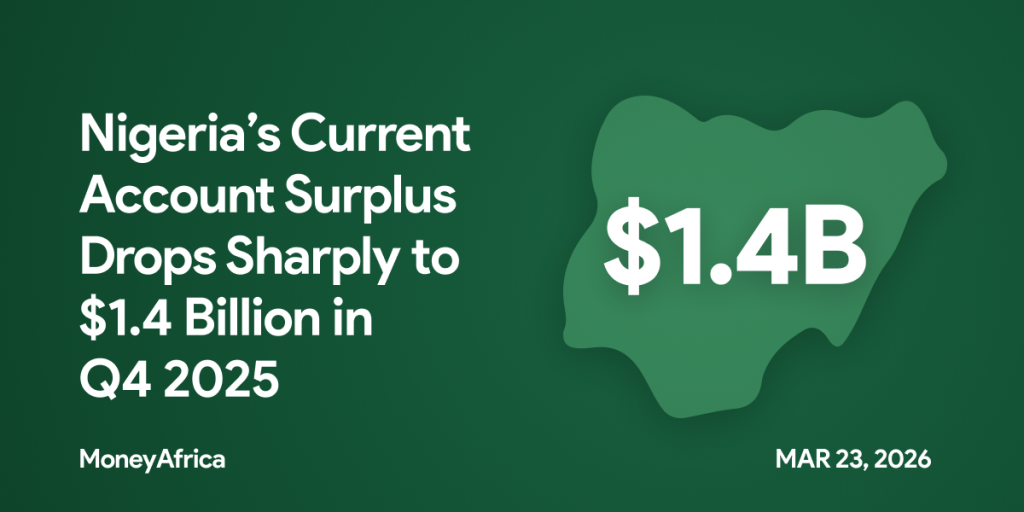
Nigeria’s Current Account Surplus Drops Sharply to $1.4 Billion in Q4 2025
Nigeria’s current account surplus, which measures how much the country earns from the rest of the world compared to what it spends, fell sharply by 65.5% to $1.4 billion in Q4 2025, down from $4.06 billion in Q3 2025. This is the weakest current account surplus since Q2 2023, just before the FX reforms that strengthened Nigeria’s external balance.
The decline was mainly driven by weaker export earnings and rising imports. The goods trade surplus dropped by about 61% to $1.77 billion as crude oil exports fell by over 20.5% and refined petroleum product exports fell by 14.0%.
Similarly, imports increased, particularly non-oil imports, which rose by nearly 25%. This suggests that more foreign exchange was used to meet demand for goods and services from outside the country.
Despite the moderation in current account surplus, the CBN’s reserves expanded by 7.0% to $45.8bn in December 2025 from $42.8bn in September 2025, driven by a doubling of capital inflows from foreign investors from $2.5bn in Q3 2025 to $5.3bn in Q4 2025.
Looking ahead, a recovery in exports remains necessary to sustain the stability in exchange rate and growth in external reserves. A sustained reduction in the current account surplus would eventually frighten the foreign investors who have invested more than $20bn in Nigeria since 2023.
Key Takeaway:
- Nigeria is still earning more than it spends globally, but the sharp drop in surplus shows that external strength is weakening. Lower oil earnings and rising imports could increase pressure on the naira and the broader economy if not reversed.
FX Update
The Naira Gained Despite Middle East Conflict
Since the outbreak of the US/Israel-Iran conflict in the Middle East, the US dollar has gained against other major currencies, especially countries vulnerable to high oil prices. In Nigeria, after some periods of weakness, the naira has continued to gain against the USD due to support from the CBN.
At the official CBN window (NFEM), the dollar closed at ₦1,362/$1 on Wednesday, March 18, 2026, compared to ₦1,366.23/$1 the previous Friday, March 13.
In the parallel market, the exchange rate appreciated to about ₦1,395–₦1,405/$1 from around ₦1,405–₦1,415/$1 last week.
The pressure on the naira is reflected in the moderation in the external reserves to $49.8bn as at March 17, 2026, from a peak of $50.0bn on March 11, 2026. A sustained weakness in oil production and a prolonged conflict in the Middle East, which can soften or reverse capital inflows, are the negative risks to external reserves and the naira.
Key Takeaway:
- The naira gained slightly in both the official and parallel markets this week. However, falling external reserves, weak oil production, and ongoing tensions in the Middle East remain key risks that could put pressure on the currency.
Remember to save dollar-based goals in dollars, which can be done with apps like Ladda. Just visit www.getladda.com to download. You can also earn up to 8% for dollars saving and 20% by investing in naira savings.
Equities Update
NGX Rises Above 201,000 as Banking and Industrial Stocks Lead Gains
The Nigerian stock market closed higher in a shortened trading week, as the All-Share Index advanced by 1.39% week-on-week, rising to 201,156.86 points from 198,407.30 points recorded in the previous week. The market continues to show strong momentum, with the year-to-date (YTD) return now at approximately +34.5%.
The gains were mainly driven by industrial goods and banking stocks. The industrial goods sector rose by 9.67%, supported by continued demand for infrastructure and construction-related companies. The banking sector gained 4.31%, as investors positioned ahead of earnings releases and dividend announcements.
On the other hand, some sectors recorded losses. The oil and gas sector declined by 4.78%, largely due to profit-taking after earlier gains. The consumer goods sector dipped slightly by 0.10%, reflecting caution amid weak consumer spending, while the insurance sector fell by 0.42% as investor interest remained relatively low.
Key Takeaway:
- The market remains on an upward path, but the rally is becoming more targeted. Investors are focusing on banking and industrial stocks with stronger earnings prospects, while some sectors are experiencing pullbacks due to profit-taking and underlying economic pressures.
Fixed Income Update
CBN Raises Nearly ₦3 Trillion as T-Bill Rates Increase
The Central Bank of Nigeria (CBN) raised nearly ₦3 trillion over the past two weeks on behalf of the FG through treasury bill auctions.
At the previous week’s auction, rates went up compared to the previous auction earlier in the month. The 364-day rate increased from 15.90% to 16.73%. The 91-day bill also moved up from 15.80% to 15.95%, while the 182-day bill stayed the same at 16.65%. This shows that even though demand was strong, investors wanted slightly higher returns, especially for the 364-day bill.
After the auction, the secondary market moved in a different direction as investors increased demand. Yields on the 91-day T-bill dropped slightly from 16.30% to 16.25%, while the 182-day remained at 17.72%. The 364-day bill yield also came down from 19.61% to 19.45%.
In the long-term debt market, FGN bond yields fell from 15.69% to 15.60%.
Key Takeaway:
- T-bills are still in high demand, especially longer-term bills. Rates at the auction are rising, showing investors want better returns, while rates in the secondary market are coming down due to high system liquidity.
You can invest in treasury bills to save for your short-term goal on rent, schools, fees, etc. through Ladda—a fintech app that helps you save at high returns.
For long-term goals, naira-denominated fixed income instruments are not suitable due to inflation and currency risks
Star-Spangled Banner Recap
Global Stocks Fall as Oil Prices Rise
Global stock markets fell last week as tensions in the Middle East grew, especially between the United States, Israel, and Iran. The prolonged closure of the Strait of Hormuz, a key route for oil, has pushed Brent crude above $110 per barrel. Higher oil prices increased worries about inflation and made investors cautious.
In the United States, stocks dropped across the board. The S&P 500 ended the week around 6,506, down 1.5%, the Dow Jones fell about 1%, and the Nasdaq lost roughly 2%, hurt by technology and growth stocks. Energy stocks gained from higher oil prices, while Industrials, Consumer Discretionary, and Financials struggled. Defensive sectors like Utilities and Health Care held up better as investors looked for safer options.
In Europe, markets also weakened. The FTSE 100 fell 1.44%, Germany’s DAX dropped 2.01%, and France’s CAC 40lost 1.82%. Financials and industrials led the decline, while defensive sectors like Consumer Staples and Utilities were more stable.
Asian markets were also affected. Japan’s Nikkei 225 fell 3.38%, China’s Shanghai Composite slipped 1.24%, and Hong Kong’s Hang Seng declined 0.88%. Export and manufacturing sectors were hit the most because of higher energy costs and slower global growth.
Key Takeaway:
- Rising oil prices due to Middle East tensions made investors cautious. Stocks fell in the US, Europe, and Asia, while defensive sectors gained.
Remember to always save for your dollar goals in dollars. You can do this with us on Ladda—a fintech app that helps you save at high returns.
We hope you find this edition insightful, and as always, stay focused on your financial goals!