
MoneyAfrica| Investment Research
Weekly Market Commentary
February 23, 2026.
Good morning, readers, and welcome to this week’s edition of our stock market newsletter!
As always, our newsletter is divided into two sections: Green White Green, covering the Nigerian stock market, and the Star-Spangled Banner, focusing on the US market.
Green White Green Recap
Macro Update
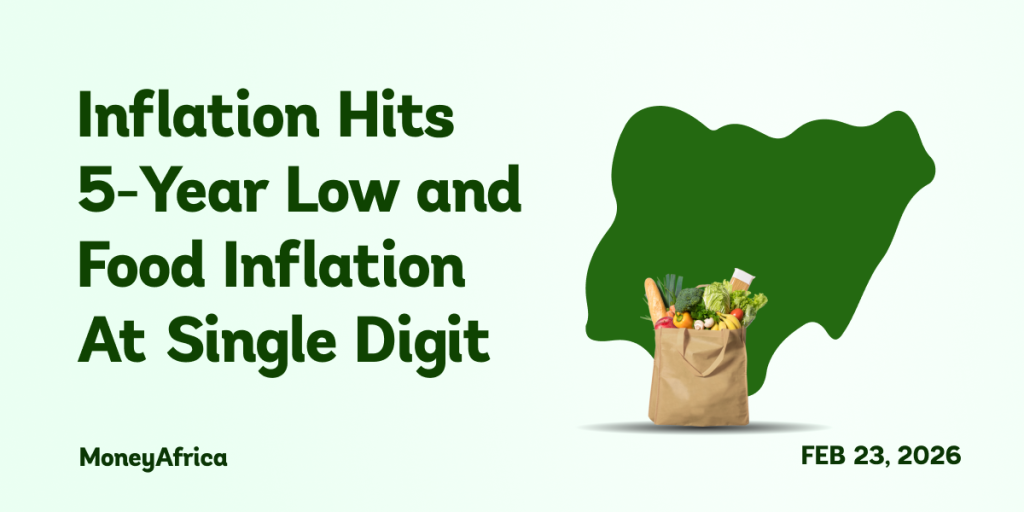
Inflation Hits 5-Year Low and Food Inflation at Single Digit
It is a rare occurrence for general consumer prices to be falling in Nigeria, but that has been the story of the past four months. Last week, the National Bureau of Statistics (NBS) reported that Nigeria’s headline inflation rate eased slightly to 15.10% year-on-year (January 2026 vs January 2025) from 15.15% in December 2025. This was driven by a sharp reduction of 2.88% in consumer prices month-on-month (January 2026 vs December 2025), the largest since March 2004.
Over the past six months, the rate at which prices are increasing has slowed down, helping to lower inflation from a peak of 34.8% in December 2024 to the lowest since November 2020.
Most notably, food inflation dropped significantly to 8.89% year-on-year, which is the first single-digit reading since May 2015. This dramatic cooling in food costs was driven by a successful harvest season and an appreciating exchange rate.
Similarly, core inflation, which measures the change in prices of non-volatile items such as energy and farm produce, fell to 17.7% from 18.6% in December 2025. This is the lowest core inflation since December 2022, driven primarily by the appreciation in the exchange rate.
If the CBN’s stance of a stable exchange rate is sustained, headline inflation could potentially reach single-digit for the first time since January 2016.
Key Takeaway:
- Falling food prices have driven headline inflation to the lowest since November 2021 and a single-digit headline inflation rate is within reach if the CBN sustains its exchange rate policy stance.
FX Update
Naira Hits 2026 High as Reserves Climb to Nearly 13-Year Peak
The Nigerian naira was strong last week (ending February 20, 2026), touching an intraday peak of ₦1,337 in the week.
In the official market (NFEM), the naira appreciated by 0.67% to close at ₦1,346.32, compared to ₦1,355.41 in the prior week. The parallel market saw an even more dramatic recovery, strengthening by 5.1% to settle at ₦1,348 from ₦1,420.48. The gap between the official and black market rates is effectively nonexistent at a ₦1.68 difference.
This stability is anchored by Nigeria’s external reserves, which hit a milestone of $48.50 billion on February 17, 2026—a level last seen nearly 13 years ago in May 2013, the reserves have sustained a massive $2.47 billion growth over the last 30 days.
With falling global interest rates and rising oil prices, we expect a sustained strength in the external reserves and exchange rate.
Key Takeaway:
- The naira appreciated to ₦1,346 and there was a near-total disappearance of the “black market premium” driven by rising external reserves which peaked at a 13-year high of $48.50 billion.
Remember to save dollar-based goals in dollars, which can be done with apps like Ladda. Just visit www.getladda.com to download. You can also earn up to 8% for dollars saving and 20% by investing in naira savings.
Equities Update
₦125 Trillion Milestone: NGX ASI Breaks 194,000 as Liquidity Floods the Market
The Nigerian stock market recorded a historic week between February 16 and 20. The Nigerian Exchange All-Share Index (ASI) rose by 6.95% to close at 194,989.77 points, its highest level ever. This strong rally added about ₦8.2 trillion to investors’ portfolios, increasing the market value of listed companies to ₦125.2 trillion.
The rally was primarily ignited by PenCom’s February 9, 2026, policy shift, which raised equity investment caps to unlock approximately ₦3.5 trillion in potential liquidity. The revised limits are RSA Fund I: Increased to 35% (from 30%); RSA Fund II: Increased to 33% (from 25%); RSA Fund III: Increased to 15% (from 10%),; RSA Fund VI (Active): Increased to 33% (from 25%)
The Industrial Goods sector led gains at 10.10%, closely followed by the Oil and Gas sector, which soared 8.66% to hit a jaw-dropping 52.73% year-to-date return. Consumer Goods (+6.10%), Banking (+5.68%), and Insurance (+4.73%) all posted significant gains as investors raced to secure positions in blue-chip stocks like Seplat, BUA Cement, and Zenith Bank ahead of dividend declarations.
The market remains exceptionally vibrant as the NGX transforms into a primary destination for both local pension assets and returning foreign portfolio capital.
Key Takeaway:
- The NGX reached a peak level of 194,000 points, driven by an increase in demand from pension funds and institutional investors.
Fixed Income Update
Investors Flood ₦4.3 Trillion into T-Bills as Rates Fall
There were strong bids at the treasury bills primary market auction on Wednesday, February 18. Investors bid ₦4.28 trillion, nearly four times the ₦1.15 trillion offered. The 364-day bill remained the star of the show, attracting ₦4.07 trillion (over 95% of total demand) as investors scrambled to lock in long-term returns.
Considering the strong demand, the CBN aggressively slashed interest rates. The 364-day stop rate crashed by 109 basis points from 16.99% in the previous auction to 15.90%. Meanwhile, the 91-day rate saw a marginal dip to 15.80% (from 15.84%) while the 182-day rate remained flat at 16.65%. Notably, the CBN opted for an aggressive allotment strategy this week, selling ₦1.91 trillion worth of bills—nearly double its initial target—to mop up the excess liquidity.
Following the auction, the secondary market saw a cooling of yields as unsuccessful bidders from the primary auction rushed to buy instruments in the open market. The average yield for the 364-day bill in the secondary market settled at 18.35%, a significant drop from last week’s 18.98%. Yields on the shorter tenors followed a similar downward path: the 91-day yield fell to 16.18% (from 16.74%), and the 182-day yield eased to 17.36% (from 17.42%).
Benchmark bond yields also continued their steady decline, softening slightly to 15.92% as the overall market anticipates a broader downward shift in the interest rate environment.
Key Takeaway:
- The sharp drop in interest rates shows that the financial system remains awash with significant liquidity. With inflation cooling, there is a fierce race among investors to lock in high yields before the Central Bank lowers them even more in the coming months.
You can invest in treasury bills to save for your short-term goal on rent, schools, fees, etc. through Ladda—a fintech app that helps you save at high returns.
For long-term goals, naira-denominated fixed income instruments are not suitable due to inflation and currency risks
Star-Spangled Banner Recap
Global Markets Bounce Back as Supreme Court Topples Key Tariffs
In the week ending February 20, 2026, investors cheered as the US Supreme Court struck down President Trump’s sweeping emergency tariffs. The decision declared illegal the use of the International Emergency Economic Powers Act (IEEPA) for broad trade levies, providing an immediate boost to trade-sensitive sectors.
This legal victory helped offset a shocking moderation in US economic growth in Q4 2025 to 1.4%, far below the 4.4% recorded in the previous quarter. While the Trump administration immediately countered the ruling by announcing a new 10% global tariff under different statutory powers, the market’s positive view on the court’s intervention sparked a rally that helped most indexes finish the week in the green.
Global performance was strong across the board, led by a massive rebound in Europe and the UK. The CAC 40 in France and the FTSE 100 in London were the week’s standouts, surging 2.39% and 2.30% respectively, as defensive and industrial stocks benefited from the tariff relief. In the US, the Nasdaq recovered 1.24% for the week, clawing back some ground after the “AI scare” of previous weeks, while the S&P 500 rose 1.04%.
Meanwhile, Asian markets were mixed due to Lunar New Year closures in China and South Korea. However, Japan’s Nikkei 225 managed a marginal 0.03% gain, holding onto its impressive 12.88% year-to-date lead following Prime Minister Sanae Takaichi’s legislative supermajority.
Key Takeaway:
- The Supreme Court’s ruling against emergency tariffs acted as a powerful tailwind for global stocks. We expect investors to react to the impact of the new 10% global tariffs in the coming week.
Remember to always save for your dollar goals in dollars. You can do this with us on Ladda—a fintech app that helps you save at high returns.
We hope you find this edition insightful, and as always, stay focused on your financial goals!