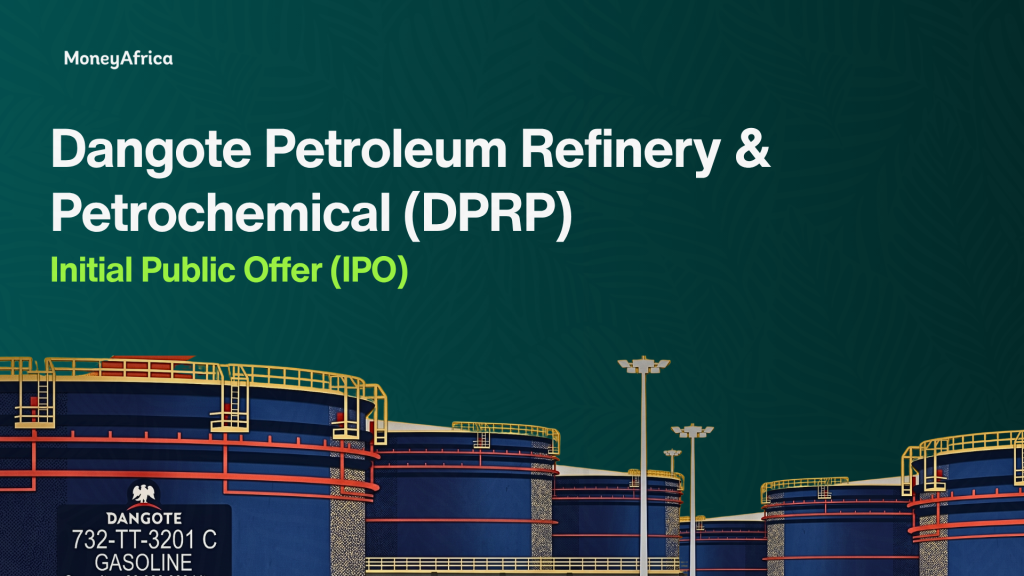
Dangote Petroleum Refinery &
Petrochemical (DPRP)
Initial Public Offer (IPO)
On September 14, 2026, the Initial Public Offer (IPO) for the Dangote Petroleum Refinery and Petrochemical (DPRP) will be open for subscription. An IPO is the first time a company sells its shares to the public. With 4.1 billion shares on offer at N525 price per share , Dangote Refinery is raising N2.15tn from investors. Post-IPO, shares outstanding will rise to 124.2bn.
In this brief, we consider the investment case for participating in the IPO. We explain the refinery’s operations, its financial performance, growth plans and the risks to performance. More importantly, we estimate its fair value compared to its offer price. Our analysis is limited by the lack of notes to the financial statements in the prospectus.
We conclude with a recommendation on its role in your portfolio and how to size your position.
Please note that this brief is for information purposes only. This is not financial advice and you should talk to a financial advisor before making investing decisions related to this IPO.

Africa’s Largest Refining Operation
With 700,000 barrels per day (bpd) nameplate capacity, following a rerating from 650,000 barrels per day in 2026, the DPRP is one of the most ambitious industrial projects in Nigeria’s history and the largest petroleum refinery in Africa. It took almost a decade from groundbreaking to production, with the project starting in 2016 and commencing operations in 2024. As at H1 2026, the refinery was fully operational.
The refinery is complex enough to process different grades of crude, but mostly the light, sweet crude popular in Nigeria. Management notes that they have processed 36 different crude grades sourced globally. DPRP was only able to source 60.0% of its crude from Nigeria in 2025. The refinery sources about 40.0% of its crude from outside markets like the US, South America, Africa and the Middle East.
The refinery produces petroleum products such as Premium Motor Spirit (PMS or petrol), Automotive Gas Oil (AGO), Aviation Turbine Kerosine (ATK/jet fuel), Reduced Crude Oil (RCO), Carbon Black Feedstock (CBFS), Liquefied Petroleum Gas (LPG), Propane and petrochemicals, with many other products expected to come on stream. The petroleum products are processed to meet strict, global environmental standards, enabling the refinery to be competitive across global markets. The product yield in the 12 months to June 30 2026 was 39.9%, 21.4%, 20.6% and 16.6% for PMS, AGO, ATK, and RCO & CBFS respectively.
The refinery is designed to maximise yields of higher value products and its configuration allows for some yield adjustment relative to product economics. Put simply, the refinery can prioritise more profitable products.
We recommend the EIA’s article on how crude oil is refined for better understanding of a refinery’s operations.
Single Train Risk, Cost Efficiency and Flexibility
The Refinery is located at the Dangote Industries Free Zone (DIFZ) in Ibeju Lekki, Lagos State, on the coast of the Atlantic Ocean. It is regulated by the Oil & Gas Free Zone Authority. DPRP enjoys generous tax incentives on its sales to Nigeria until 2028 and on its exports and imports due to the free trade zone. Until the new tax act of 2025, there was a blanket exemption, but 15% is now proposed. Also, the location and the large, supportive infrastructure (maritime logistics) built ensures efficient sourcing of materials, crude and feedstock and the export of petroleum products.
The scale of its operations supports unit cost competitiveness. DPRP is the largest single-train refinery in the world at 700,000 barrels per day capacity on its Crude Distillation Unit (CDU). However, the single-train design is risky unlike refineries that run multiple processing lines for resilience, especially through staggered maintenance operations. An outage in any major unit constrains operations. The upside is cheaper operating cost, while the downside is protracted outages that could hurt production, lead to a default on supply obligations and weaken earnings margins.
This risk was realised in the 200,000 barrels per day Residue Fluid Catalytic Cracking (RFCC) unit with recurring issues since April 2025. The unit ran at 66% capacity in May 2026 and there was a forced shutdown in August 2026 with repairs expected to be completed by late 2026.
However, the refinery retained some flexibility due to its design. When the RFCC is down, the CDU, vacuum unit, mild hydrocracker and hydrotreaters continue to produce jet fuel and diesel as these distillates do not depend on the RFCC. The refinery can also change its crude slate, the crude grade processed, to lighter crude which yields more distillates and less residue. However, because vacuum residue can only be processed in the RFCC, crude throughput tends to reduce.
In extreme situations, the DPRP has an import license which enables it to import refined petroleum products to ensure supply continuity. Overall, while these in-built measures ensure the Refinery doesn’t fail to meet its commitments, they do not prevent the erosion of earnings margins.
Doubling Capacity to 1.4 mbpd by 2029
The earnings growth of a refinery is typically driven by capacity expansions and a higher gross refining margin. While the latter is driven mainly by market conditions, capacity expansions are deliberate. However, once capacity utilisation peaks or normalises, volume growth potential is weak, and refining margins drive earnings.
Capacity expansions enable scale, which provides many benefits. The refinery can attain even more efficiency with lower operating costs, ensure continuity if the initial train is down, and compete better locally and globally. The increased production of petrochemicals also provide diversification benefits that enable growth.
DPRP plans to invest $14.3bn in doubling capacity to 1.4 million barrels per day (mbpd) by 2029. This expansion will increase throughput, the volumes of petroleum products and petrochemicals sold and create more value for shareholders through larger profits. Locally, the refinery can remain the price setter.
The expansion is ambitious and operates on a tight schedule of 3 years. Given the experience of DPRP in delivering the first 700,000 bpd capacity, we expect execution risks to be better managed. However, we do not rule out cost overruns and a longer execution timeline.
Competition is Global
Historically, approximately 53% of DPRP’s petroleum products are exported. Domestically, the DPRP supplied 100% of locally produced PMS and 87.6% of total supply into the market as at May 2026, including imports. Nigeria consumes roughly 45 million litres of PMS daily. The refinery uses import parity pricing, which combined with its low costs, even on imported feedstock, gives it a big advantage over importers.
DPRP does not face any competition locally today. While Nigeria has a refining capacity of 506,000 barrels per day outside DPRP, the government’s 445,000 barrels per day refineries are currently shut down and fail to produce at any meaningful scale consistently. The rest are modular refineries lacking in sophistication, scale and diversified products.
The 200,000 barrels per day BUA Refinery expected to come on stream in 2027 pales in size and DPRP’s planned doubling of capacity by 2029 gives it a strong grip on the local market. While import licences are still being granted, the scale of imports have reduced due to undercutting by DPRP. In addition to this, DPRP continues to lobby for a full ban and duty on imports, which will give it more control over local market prices and create conditions to earn outsized margins.
Competition is, however, global. The DPRP faces competition from existing refineries and ongoing projects within Africa and outside. DPRP is a price taker in the global market, and capacity utilisation and margins could suffer due to overcapacity globally. However, its scale would support competitiveness.
The US-Iran War is DPRP’s Market Opportunity
Refining is a margin business. DPRP sources crude and feedstock to produce petroleum products for domestic and export sales, with the difference between the value of petroleum products and cost of crude and feedstock being its gross refining margin (GRM).
We estimate the GRM at $26.5 per barrel in H1 2026, more than doubling from $12.6 per barrel in H1 2025.
Since the US-Iran War started in February 2026, refiners have earned better margins due to supply shortages. However, a war-driven GRM is not sustainable over the long-term. While there is uncertainty about the duration of the war, margins will eventually reduce with time.
DPRP’s IPO is timed to perfection, opening at a time when prices and margins have climbed, and with it the valuation of refiners. We are cautious that the IPO price reflects the premium created by the disruption caused by the US-Iran War. We account for this in our valuation and investors must consider this in their allocation decisions.
We note that a great company can be bought at the wrong price. It is important to consider entry pricing when making an investment allocation even in great businesses. A steep price can otherwise make a great investment lacklustre and it provides no margin of safety, especially when expectations are unmet.
Paying a Dollar Dividend
DPRP has indicated that investors can receive their dividend in USD or Naira. The prospects of receiving a dollar dividend on a Naira investment strengthens the investment case for investors.
However, DPRP provided no guidance on when dividend payments will start, payment consistency, and target yield. This is important because the refinery is in an expansion phase and would prefer to retain earnings to fund its expansion. Only $4.1bn is being raised in equity to fund a $14.3bn expansion programme until 2029. The outstanding $10.2bn will be funded with debt and retained earnings in the next three years, making the chances of a strong dividend distribution significantly lower.
In a market without capital controls and FX conversion risk, investors should be indifferent between receiving USD or Naira. After all, there shouldn’t be a difference in receiving $1 or N1,326 based on the current exchange rate. Paying dividends in USD says nothing about the quality of dividends. Dividend yield and growth matter more.
For local investors, especially those who mostly spend in Naira, a dollar dividend can also be inconvenient. However, with Nigeria’s inefficient FX regime of the past decade, we cannot rule out a situation where dollar dividends would be paid in Naira at a massively overvalued official rate. Imagine a situation where a $1 dividend is paid at the official rate of N465 instead of the parallel market rate of N750, as in early 2023. That would be a devastating 38% haircut.
For foreign investors, the value is clear. Given the size of their positions, FX conversion risk is very high and repatriating capital isn’t easy. Dollar dividends can help them avoid these issues.
Overall, for our clients who are mostly retail investors, we believe the significance is exaggerated. Retail clients who prioritise aggressive portfolio growth over income should not be swayed by the prospects of USD dividends. Meanwhile, retail investors who prioritise income should instead focus on the quality of dividends, which we believe many other companies on the Nigeria Exchange (NGX) can provide.
Turning a Profit
In H1 2026, DPRP turned a profit, mostly driven by the ramping up of production volumes to capacity and improved gross refining margin. Volumes of PMS grew 95.9% to 6 MMT (million metric tonnes), AGO grew by 62.3% to 2.9 MMT and ATK increased 46.6% to 3.0 MMT as the refinery ramped up production. Realised prices rose by 34.9%, 78.1% and 64.7% for PMS, AGO and ATK respectively, driven by the US-Iran war.
Therefore, revenue doubled year on year (y/y) to $13.9bn, offsetting the 110.6% increase in cost of sales of $11.4bn to turn a gross profit of $2.5bn. Operating profit and EBITDA also rose significantly to $2.4bn and $2.6bn respectively. Gross profit margin rose from 2.6% to 17.9% as at H1 2026, EBIT margin rose from 1.1% to 17.0% and EBITDA margin rose from 4.1% to 18.5%.
Profit before tax (PBT) and profit after tax (PAT) increased to $2.1bn and $1.8bn respectively from losses of $282.1m in H1 2025. The effective tax rate was 13.6%, demonstrating the tax incentives. PBT Margin and PAT margin rose to 15.1% and 13.1% respectively from -3.9% each in 2025.
The financial year 2026 will be the first full year of profit since the commencement of production. Annualised ROAA, ROIC and ROAE are strong at 19.9%, 39.3% and 43.5% respectively in H1 2026. However, this is unlikely to be unsustainable because refining margins tend to normalise. DPRP provides a gross refining margin guidance of $24.2 per barrel in 2026.
Valuation
We value DPRP’s equity at $35.8bn using only the Discounted Cash Flow model. With 124.2bn shares post IPO, we value DPRP at $0.29 (N387.7) per share. This means the IPO price per share at $0.39 (N525) per share is at a premium of 35.4%. Our one year target price is $0.32 (N433.8) per share.
Our valuation is three stages, reflecting existing operations, future expansion and terminal value. Income taxes are fixed at 15% over time, and we normalised gross refining margins to reflect the unsustainable nature of H1 2026 performance. We have also accounted for benefits likely to be derived from a related upstream production party in terms of crude sourcing and working capital.
Our weighted average cost of capital is 11.8%, cost of debt of 8.3% and a cost of equity of 14.0%. Our cost of capital assumptions are a risk free treasury yield of 4.5%, a mature market equity risk premium of 5.0%, a Nigeria country risk premium of 5.0%, and a levered beta of 0.9. We assume a 30:70 debt to equity split over time. The valuation tables are here.
The Smart Retail Investing Strategy
At Ladda and Money Africa, we are long-term investors. We prioritise economies and assets that can deliver strong returns over 10 years.
Our Nigerian stocks must meet a minimum and sufficient investment criteria. Our minimum criteria for companies is to have a strong market share or a market leading position, strong growth potential, strong returns on invested capital, which should be higher than the cost of capital for value creation, operate in a large and growing market, and have a strong competitive advantage.
Our sufficient investment criteria prioritise companies structurally positioned to remain resilient in the face of an economic crisis in Nigeria. We prioritise export potential, ability to set pricing, sales of tradable goods, and investments abroad. Also, supportive government regulations that are sustainable.
The Dangote Refinery excels on both criteria, therefore we consider it a potentially great business.
However, we recommend that investors buy great businesses at fair or discounted prices. Steep premiums reduce the margin of safety of investors and can condemn investors to poor returns if the company does not surpass expectations.
In view of this, we believe investors should size their position carefully in the IPO. Importantly, investors should not expect quick returns but stick to principles that boost their financial resilience such as maintaining an emergency funds and savings portfolio for emergencies and short-term goals. While high refining margins due to the prolonged US-Iran war and thin liquidity on the stock exchange can keep share price higher post listing, there are no guarantees.
We also believe that the investors should think of the refinery as an addition to their Nigerian portfolio but not the sole focus. Some Nigerian businesses still offer great earnings margins and return on capital at fair or discounted prices. We do not recommend selling these businesses to finance this IPO subscription.
For growth investors who want significant returns, position with caution given the pricey valuation of DPRP. There are alternative opportunities likely to perform better over the long-term. Buying some of your intended purchase, and accumulate when prices dip in the future.
Income investors prioritise dividend paying stocks. However, dividend payment in the expansion phase might not be sizable, consistent or growing. Therefore, you should have a medium term outlook. If your priority is the short-term, you can potentially earn better dividends on other companies on the Nigeria Exchange. Participate in the IPO with caution and be prepared to accumulate when prices fall over time.
Downside Risks
DPRP faces a number of downside risks which could cause it to perform below expectations long-term. There is the threat of frequent and extended downtimes to operations due to the single train nature of the refinery, which could reduce its profitability. However, this risk is mitigated by the planned doubling of capacity through a second train by 2029. The execution of this planned expansion is also a source of risk, if timelines and costs are overstretched.
There is also the threat of low capacity utilisation due to global market dynamics. Global overcapacity will hurt refining margins. The US-Iran war has supported stronger refining margins but this is likely to continue into the future.
Crude oil sourcing could be another challenge if the upstream related party is unable to ramp up production and overall domestic production in Nigeria remains weak long-term. This depends on the regulatory environment in Nigeria and the level of insecurity locally.
There are also regulatory risks that allow imports and competition to make local prices competitive, including a permanent suspension of proposed import duty on the importation of petroleum products. The return of subsidies, which puts pressure on government finances, could also put downward pressure on local petroleum product prices. Similarly, regulatory decisions about taxes on sales to the Nigerian customs region have huge implications, especially if the current tax break is not extended.
Risks in the form of geo-politics, pandemics, wars, environmental disasters and many others can also hurt its operations.
Disclaimer
This document has been prepared by Ladda Technology Limited for information purposes only. It does not constitute, and should not be construed as, investment advice, a recommendation, an offer to sell or a solicitation of an offer to buy any security, or an invitation to engage in any investment activity.
The information contained in this document has been obtained from sources believed to be reliable, but no representation or warranty, express or implied, is made as to its accuracy, completeness or correctness. Any opinions, estimates, projections or forward-looking statements reflect the author’s judgement as at the date of publication and are subject to change without notice. Past performance is not a reliable indicator of future results, and no assurance is given that any projection, forecast or estimate will be realised.
This document does not take into account the investment objectives, financial situation or particular needs of any specific recipient. Recipients should not rely on this document as the basis for any investment decision and should conduct their own independent assessment, including obtaining advice from a qualified financial, legal, tax or other professional adviser, before acting on any information contained herein. The value of investments and the income from them may fall as well as rise, and investors may not recover the amount originally invested.
Acronyms
AGO: Automotive Gas Oil
ATK: Aviation Turbine Kerosine
bpd: Barrels per day
CBFS: Carbon Black Feedstock
CDU: Crude Distillation Unit
DIFZ: Dangote Industries Free Zone
DPRP: Dangote Petroleum Refinery and Petrochemical
EBIT: Earnings Before Interest and Taxes
EBITDA: Earnings Before Interest, Taxes, Depreciation, and Amortization
FX: Foreign Exchange
GRM: Gross Refining Margin
IPO: Initial Public Offer
LPG: Liquefied Petroleum Gas
mbpd: Million barrels per day
MMT: Million metric tonnes
PAT: Profit After Tax
PBT: Profit Before Tax
PMS: Premium Motor Spirit
RCO: Reduced Crude Oil
RFCC: Residue Fluid Catalytic Cracking
ROAA: Return on Average Assets
ROAE: Return on Average Equity
ROIC: Return on Invested Capital
NGX: Nigeria Exchange
USD: United States Dollar