
You’re not keeping up with the Joneses. You’re funding them.

There is a wealth killer that never appears on your balance sheet.
No interest rate. No repayment schedule. No line item in any budget.
But it is compounding, against you, every time you open your phone, walk into a room, or sit across from someone whose life looks better resourced than yours.
It is comparison. And it is costing you more than your worst financial decision ever did.

Your Lifestyle Is Someone Else’s P&L
Every time you upgrade, expand, or spend in response to what someone else appears to have, you are not expressing a personal preference.
You are executing someone else’s financial agenda.
The car manufacturer who priced that model aspirationally. The brand that spent millions engineering the feeling that ownership signals status. The developer who positioned that neighbourhood as a social marker.
They built the benchmark. You are meeting it, with your own money.
In finance, we call this a wealth transfer. You are moving your net worth toward someone else’s revenue line. Willingly. Repeatedly. Usually without noticing.

The Benchmark That Never Stops Moving
Here is why comparison is structurally different from every other bad financial habit.
Most bad habits have a ceiling. Comparison doesn’t. The benchmark reprices the moment you reach it.
The ₦300,000 earner watches the ₦700,000 earner. The ₦700,000 earner watches the person who just closed a Series A. The comparison is always dynamic, structurally designed to stay just ahead of wherever you currently are.
Chasing it doesn’t mean you’re ambitious. It means your spending has been quietly outsourced to other people’s decisions.
Liquidity vs. Appearance; Know the Difference
This is worth burning into memory.
Liquidity is what you can actually deploy when you need it. Real. Functional. Accessible.
Appearance of liquidity is the performance of having money, the visible signals that communicate wealth without the underlying position to support them.
Most people spend the early years of their career building the second while the first stays dangerously flat.
The signals accumulate. The net worth does not.
Then a shock arrives, a redundancy, a medical bill, a market shift and the gap between what the lifestyle communicated and what the balance sheet actually holds becomes brutally clear.
The Real Cost; Compounded
Conservative estimate.
A professional spending ₦25,000 monthly on comparison-driven purchases, things they would not buy if visibility were removed, is deploying ₦300,000 annually in service of a performance, not a preference.
At 15 percent per annum over ten years, that ₦300,000 annually becomes approximately ₦8.2 million.
Not from a salary increase. Not from a better stock pick.
Just from redirecting money that was already leaving, toward something that compounds rather than something that depreciates the moment it’s purchased.
The Quiet Accumulator
There is an archetype in behavioural finance that never trends.
Their lifestyle gives nothing away. Their car starts reliably but generates no conversation. Their apartment is comfortable but not curated for guests.
But they have been allocating 25 to 30 percent of income to savings and investments for a decade. Consistently. Without deviation.
The compounding on that behaviour, at even a modest return, produces a net worth that would genuinely shock every person in the same room who spent those ten years performing equivalent success.
The quiet accumulator opted out of the visible race early.
And started running one with a completely different finish line.
Stop Performing. Start Compounding.
This weekend, one honest question:
How much of what I spent this month would I have spent if nobody could ever know about it?
Whatever that number is, that’s your comparison premium. The invisible monthly fee you pay to perform solvency rather than build it.
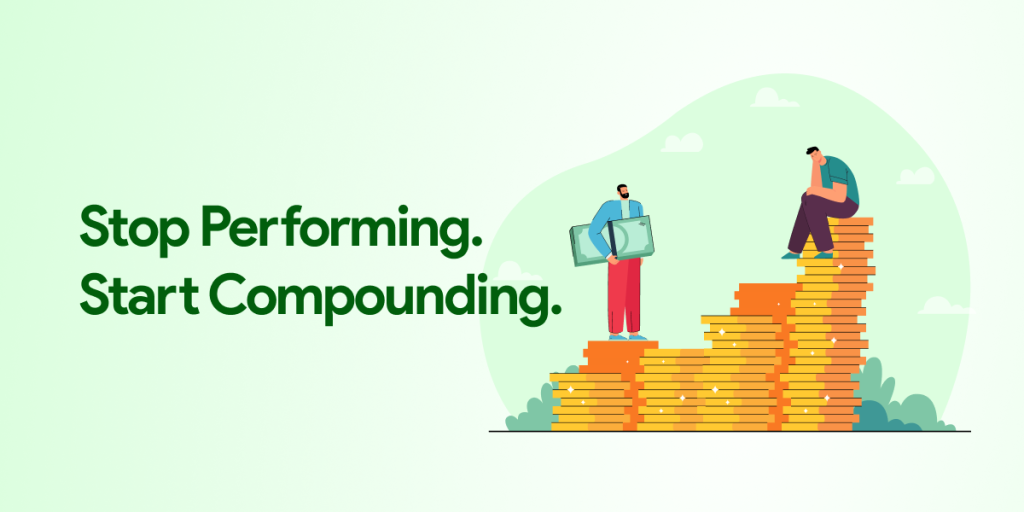
Redirect even half of it. Monthly. Automatically. Into something that compounds.
The market has never once rewarded the best-dressed participant.
It rewards the one who stayed consistent long enough for compounding to do what it does best, turns patience into something that visible wealth never quite manages to become.
Permanent.
Get started here: www.getladda.com