
MoneyAfrica| Investment Research
Weekly Market Commentary
April 06, 2026.
Good morning, readers, and welcome to this week’s edition of our stock market newsletter!
As always, our newsletter is divided into two sections: Green White Green, covering the Nigerian stock market, and the Star-Spangled Banner, focusing on the US market.
Green White Green Recap
Macro Update
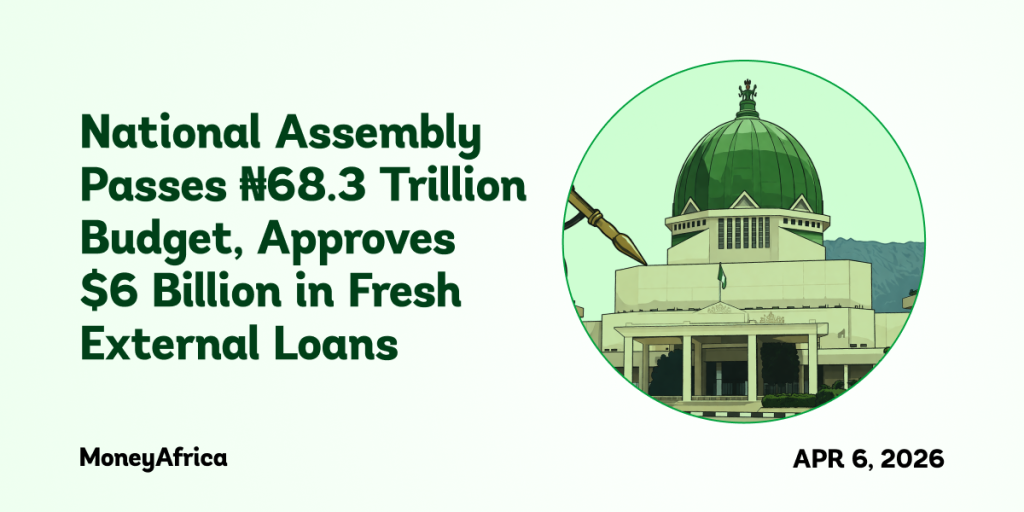
National Assembly Passes ₦68.3 Trillion Budget, Approves $6 Billion in Fresh External Loans
On March 31, Nigeria’s National Assembly passed the 2026 Appropriation Act at ₦68.3 trillion, ₦9.81 trillion higher than the ₦58.47 trillion President Tinubu originally presented in December 2025. The upward revision was justified on the basis of outstanding capital obligations carried over from the 2025 budget cycle and priority infrastructure projects that had been omitted from the original bill.
Simultaneously, both chambers approved a $6 billion external borrowing package $5 billion from First Abu Dhabi Bank via a structured Total Return Swap arrangement for budget support and debt refinancing, and $1 billion from UK Export Finance through Citibank for the rehabilitation of the Lagos Port Complex and Tin Can Island Port.
The numbers warrant close attention. Of the ₦34.33 trillion in projected 2026 revenue, approximately ₦15.91 trillion, nearly 46% is earmarked for debt servicing alone. That leaves very little fiscal headroom for productive spending. A growing share of new borrowing is also being used to service existing debt rather than fund new investment, a dynamic that raises questions about long-term debt sustainability.
Key Takeaway: The budget passage clears a key fiscal uncertainty for 2026, and the $5 billion Abu Dhabi facility provides breathing room for near-term government financing. But with almost half of revenue going to debt service and a deficit running at approximately 4.28% of GDP, Nigeria’s fiscal position leaves little room for error. Watch how the CBN manages the naira impact as these dollar inflows begin arriving in tranches.
FX Update
Naira Gains on the Week: Closes at ₦1,378 as Reserves Slip Below $50 Billion
The naira ended the week stronger. In the official NFEM window, the currency appreciated 0.58% on Wednesday April 1 to close at ₦1,378.70, recovering from ₦1,386.72 at the end of the prior week, a week-on-week gain of approximately ₦8. By Thursday April 3, the last trading day before the Good Friday holiday, it had firmed further to ₦1,378.26, extending the gains into the start of Q2.
In the parallel market, the dollar weakened slightly from ₦1,425 the previous week to ₦1,410–₦1,415 by Thursday, a narrowing of the black market rate that reflects improved supply in the official window. The spread between the official and parallel rates now stands at approximately ₦32, wider than the near-zero gap recorded in February but still far below the distortions of prior years.
On the reserves front, Nigeria’s external buffers dipped slightly below the $50 billion mark, settling at approximately $49.50 billion, down from $50.45 billion earlier in the quarter, as debt servicing obligations and CBN market support operations drew down the position. The decline is modest and reserves remain at their strongest levels in over a decade. Supporting the FX position is Bonny Light crude holding firmly above $100 per barrel, sustaining steady dollar inflows into the federation account.
Key Takeaway: The naira gained ground this week in both the official and parallel markets, a positive signal as Q2 begins. The modest decline in reserves from $50.45 billion to $49.50 billion bears watching but is not alarming at current levels. The key risk remains the Iran conflict’s dual effect as higher oil prices support inflows, but rising shipping costs threaten imported inflation.
Remember to save dollar-based goals in dollars, which can be done with apps like Ladda. Just visit www.getladda.com to download. You can also earn up to 8% for dollars saving and 20% by investing in naira savings.
Equities Update
NGX Gains 0.39% in Easter-Shortened Week: Banking and Oil & Gas Lead, Insurance Bleeds
The Nigerian stock market posted a modest but positive performance in a shortened trading week. Despite trading only four sessions, the market managed to inch forward. The NGX All-Share Index appreciated by 0.39% to close the week at 201,698.89 points, while market capitalization rose by 0.65% to ₦129.806 trillion, extending the index’s year-to-date return to an impressive 29.62%.
The Banking Index gained 0.71% for the week, extending its month-to-date return to 3.35% and year-to-date to 26.86%. Banks continue to benefit from high interest rates and strong earnings visibility. The Oil & Gas Index was essentially flat at +0.02% for the week, though its year-to-date return of 63.97% makes it the best-performing sector on the exchange this year, a direct beneficiary of elevated crude prices.
The Industrial Goods Index slipped 0.24%, though it remains up a stunning 54.62% year-to-date, anchored by cement and building materials companies benefiting from infrastructure spending. The Consumer Goods Index was the notable underperformer this week, falling 1.74%. A sector feeling the early pressure of rising food input costs and softening consumer spending power. The Insurance Index was the worst performer, shedding 4.25% for the week, weighed down by a broad pullback across smaller capitalization names.
Key Takeaway: The market is consolidating above 201,000 points rather than retreating. A healthy behaviour after a significant run. The sectoral picture is subtle: Oil & Gas and Banking remain the structural winners, while Consumer Goods is beginning to show the strain of rising input costs. The near-30% year-to-date return remains one of the strongest performances globally.
Fixed Income Update
CBN Lines Up ₦3.95 Trillion Treasury-Bill Programme for Q2: Secondary Market Yields Drift Lower
No primary market T-bill auction was held this week, but the CBN made a significant announcement. The Central Bank of Nigeria plans to auction ₦3.95 trillion in treasury bills in the second quarter of 2026, beginning from April 8. The projected net issuance amounts to ₦750 billion after settling ₦3.2 trillion in maturing bills by the end of June.
The programme highlights a strong preference for longer-dated instruments, with ₦2.85 trillion, the bulk of the issuance, allocated to 364-day Treasury Bills. In comparison, the CBN plans to issue ₦700 billion in 91-day bills and ₦400 billion in 182-day bills. The first auction on April 8 will offer ₦700 billion.
The secondary market saw a cooling of yields, a sign that the market is pricing in continued monetary easing ahead. The average yield for In the Secondary Market, 364-day bills saw a slight decline in yields to reach 19.08% (from 19.19%) the week before. The 182-day bills also eased slightly to 17.93% (from 17.98%). The 91-day bills eased downward to 16.66% (from 16.70%).
Key Takeaway: Secondary market yields are drifting lower, the direction is clear even if the pace is gradual. The March 2027 NTB at 19.08% still represents excellent risk-free returns for patient investors. The April 8 auction stop rate will set the tone for the rest of Q2. If you have short-to-medium term savings goals, the window for locking in elevated yields is narrowing.
You can invest in treasury bills to save for your short-term goal on rent, schools, fees, etc. through Ladda—a fintech app that helps you save at high returns.
For long-term goals, naira-denominated fixed income instruments are not suitable due to inflation and currency risks.
Star-Spangled Banner Recap
Global Markets Snap Losing Streak: Hormuz Diplomacy Drives Relief Rally
Global equities posted their first weekly gain since the Iran war began, with the MSCI World Index advancing 0.93%, bringing its year-to-date return to 2.36%. The catalyst was a mid-week report that Iran and Oman were developing a protocol to monitor Strait of Hormuz traffic, briefly reducing fears of a full blockade. That single headline drove a 2.91% surge in the S&P 500 on Tuesday, its best single session since May.
For the week, the S&P 500 gained 1.04%, though its year-to-date return remains a slim 0.85% while the Dow Jones added just 0.12%, bringing its year-to-date gain to 3.02%. The Nasdaq outperformed at +1.24% for the week, but remains the only major index in negative territory year-to-date at -1.57%, reflecting the disproportionate pressure that high oil prices and inflation fears place on long-duration growth stocks.
European markets outperformed the US, with the CAC 40 surging 2.39% for the week, year-to-date now at 4.49%, and the FTSE 100 gaining 2.30%, bringing its year-to-date return to 7.61%. Europe’s bigger bounce reflects a larger relief trade given the continent’s greater dependence on Middle Eastern energy. In Asia, the Nikkei was essentially flat at +0.03% for the week, though its year-to-date return of 12.88% remains the strongest among the major indices tracked.
Key Takeaway: The global rally is real but fragile, built on unconfirmed diplomatic signals rather than a ceasefire. The Nasdaq’s negative year-to-date return is a warning sign that the easy money in tech may be behind us for now. With Q1 earnings season kicking off this week, corporate margins face their first real test against $111 oil. The Strait of Hormuz remains the single biggest market trigger for the week ahead.
Remember to always save for your dollar goals in dollars. You can do this with us on Ladda—a fintech app that helps you save at high returns.
We hope you find this edition insightful, and as always, stay focused on your financial goals!